
Escalation in the Gulf: VLCC/Suezmax Tankers Divert to the Red Sea; Explosions in Abu Dhabi; UAE Defenses Intercept Missile and Drone Causes Fire in Fujairah
A wave of VLCC and Suezmax tankers, originally destined for terminals in the United Arab Emirates (Ras Tanura, Fujairah, Zirku Island), is diverting towards the Red Sea, possibly heading towards Yanbu. Explosions were reported in Abu Dhabi, where UAE air defenses intercepted a missile threat. In Fujairah, a fire in the oil industrial area was caused by falling debris after a successful interception of a drone by Emirati defense forces.


- The energy sector and shipping routes in the Persian Gulf face significant new disruption this Friday, amid the intensification of the regional conflict. A significant number of large oil tankers (VLCCs and Suezmax) have altered their routes, diverting from terminals in the United Arab Emirates towards the Red Sea, while air incidents affected Abu Dhabi and Fujairah. Real-time maritime tracking data shows that multiple tankers, which had signaled or maintained as their final destination the terminals of Ras Tanura (Saudi Arabia, but with a route associated with the UAE), Fujairah or Zirku Island, began diversion maneuvers to the south, entering or approaching the Bab el-Mandeb Strait and the Red Sea. Although it is still premature to confirm that all are specifically heading for the Saudi terminal of Yanbu, the change of course coincides with increased security alerts in the Gulf and Strait of Hormuz region.
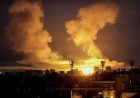
- Energy market analysts interpret the move as a precaution against potential threats to vessels or export facilities in the UAE, in the context of recent attacks attributed to Iran or its proxies. In Abu Dhabi, the capital of the United Arab Emirates, explosions were heard in the late afternoon, generating alarm in residential and commercial areas. Emirati authorities released an official statement saying that their integrated air defenses successfully intercepted a ballistic or cruise missile threat directed at the capital or its surroundings.
- No direct impacts on the ground or casualties were reported, but the incident reinforces the continued vulnerability of Gulf coastal cities to long-range vectors launched from Iran or territories controlled by Iranian allies. On the east coast of the UAE, the industrial and oil area of Fujairah experienced a moderate fire. The official UAE news agency (WAM) reported that the fire was caused by falling debris after the successful interception of a hostile drone by the country's air defense forces. Firefighters and emergency teams brought the flames under control, which affected part of the port infrastructure and fuel storage facilities. There were no reports of fatalities, but the incident temporarily disrupted operations at the port of Fujairah, one of the world's main oil bunkering and storage hubs.
- These events follow direct Iranian attacks against military bases in Gulf countries and illustrate the direct impact of the conflict on global energy security. The diversion of tankers could further pressure freight rates and risk premiums, as well as increase traffic and transit times via the Red Sea and Suez Canal. UAE and Saudi Arabian authorities remain on high alert, with enhanced coordination between the armed forces of the Gulf Cooperation Council and Western partners. As of the time of this report, there is no official confirmation of the exact origin of the aerial threats, but the pattern of incidents suggests a continuation of the Iranian retaliation strategy against targets associated with the United States and Israel in the region.
What's Your Reaction?
 Like
0
Like
0
 Dislike
0
Dislike
0
 Love
0
Love
0
 Funny
0
Funny
0
 Wow
0
Wow
0
 Sad
0
Sad
0
 Angry
0
Angry
0













Comments (0)