
Simulation of the Nepal Disaster: Himalayan Glacier Collapses, Blocks Lhende Khola, and Releases a Wave of Mud That Sweeps Everything in its Path
Reconstruction of the August 26, 2026 disaster: a large section of glacier in the Himalayas collapsed into Lhende Khola, forming a temporary lake of debris and, upon breaking through, sent a wave of mud, ice, and rocks downstream, devastating villages in Nepal and Tibet.

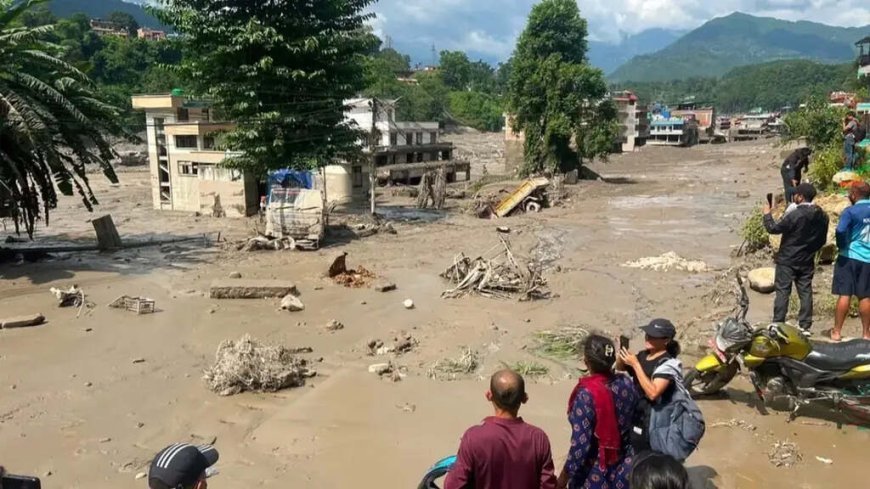
- Nepalese authorities and scientists who analyzed satellite images reconstructed the most likely sequence of the catastrophe on Wednesday, August 26: a large section of glacier in the Himalayas broke off, dumping ice, rock, and soil into the Lhende Khola, damming the river for a short period, and then bursting, releasing a dense wave of mud and debris that swept everything in its path.
- The starting point was a high-altitude glacier, around 5,200 meters, in the Langtang Himal region, on the Nepalese side of the border. Satellite images from August 24th still showed the glacier's body relatively intact. In images taken after the disaster, a clear scar appears at the point of rupture. A block of ice and rock plummeted about 1.2 kilometers vertically to the bottom of the valley.
- As it fell, the material dragged snow, sediment, and rocks. The impact was so violent that the United States Geological Survey recorded the event as a seismic signal of magnitude 5.2—initially interpreted as an earthquake, later corrected to the glacier's collapse and debris flow itself.
- Nepalese officials state that this debris temporarily blocked the Lhende Khola, forming a natural dam lake. When this barrier gave way, the impounded water rushed down all at once, mixed with thick mud, crushed ice, and pebbles. Hydrologists described the flow as “liquid concrete”: dense enough to sweep away vehicles, bridges, houses, and large rocks, instead of simply flowing around them.
- The wave entered the Bhote Koshi–Trishuli system. In downstream sections, the Trishuli River rose by up to nine meters in about 30 minutes. At least 19 bridges and about 40 kilometers of roads were destroyed. Villages in the Rasuwa district and surrounding areas, as well as facilities on the border with Tibet, were buried under mud.
- The human toll remains incomplete. Official reports and international agencies indicate hundreds of deaths—numbers that have already exceeded 390 and, in later Nepalese counts, reached 469—and more than a thousand missing on both sides of the border, including hundreds of foreigners, pilgrims, and tourists. The search was hampered by blocked roads, unstable mud, and the risk of further flooding.
- There is a second danger. The same debris that fueled the first wave formed dammed lakes upstream. Nepal and China have warned that these reservoirs continue to fill and could burst, interrupting rescues and threatening already devastated communities.
- Reconstruction is still preliminary. The immediate cause of the glacier's rupture is not yet determined—melting, weakening of the bedrock, water infiltration, or a combination of these factors. What images and official reports already support is the chain described by Nepalese authorities: the collapse at Lhende Khola, the temporary damming, and the rupture that transformed the valley into a corridor of destruction.
A simulation of how the Nepal flood disaster may have unfolded:
— Open Source Intel (@Osint613) August 27, 2026
A large section of Himalayan glacier collapsed, sending ice, rock and soil into the Lhende Khola on Aug. 26.
Nepali officials say the debris temporarily blocked the river, forming a lake that later burst and sent a…
What's Your Reaction?
 Like
0
Like
0
 Dislike
0
Dislike
0
 Love
0
Love
0
 Funny
0
Funny
0
 Wow
0
Wow
0
 Sad
0
Sad
0
 Angry
0
Angry
0












Comments (0)